Sunday, May 9, 2010

EDM613 Wk1 Response to Patricia Marcino

Original Post:

Week One-edm613-Post 3

I've been forgetting to include the title of the course-Media Asset Creation. I've just completed reading the first three chapters of The Art of Possibility. Roz and Ben present an interesting way of viewing methods to instill change in your life. I particularly like the use of metaphors and catch phrases to help you to remember.


As a teacher, like most of us are, we are always trying to come up with methods to get our students to remember content. Acronyms, numbers, rhymes, etc. all possibilities of remembering, as with music and song.

Ben says we perceive only the sensations we are programmed to receive, and our awareness is further restricted by the fact that we recognize only those for which we have mental maps or categories (page 10). This is so typical of struggling readers which is the heart of my Action Research project. Without prior knowledge of topics, it is difficult for them to understand the main idea of their passages.

I will probably finish this book tonight because it hits so close to home for me in my endeavor to help my students. I am hoping to utilize some if not all of the practices referenced.

How true is the phrase, perception generates construction.


Reference:

Zander,R. & Zander, R. (2002). The art of possibility. London: Penguin Books

My Response:

I agree with you and the book that students will only retain what they are already familiar with. I do such much front loading whenever I begin a unit, because if I don't, it won't matter what I say later, they will never remember it. That's why school is so important. Repetition of information is crucial for the content to be stored in long-term memory. Teachers who only worry about worksheets and test scores do their students a huge disservice because they never learn anything. Students MUST slowly be introduced to new information.

I like using a metaphor of jumping into an ice-cold pool. It doesn't matter how great the party or atmosphere is, you will always remember how cold the pool was, how uncomfortable it made you and how much you hated it. However, if you were to first put your feet in, then splash water on your arms and slowing work your way in, the situation remains pleasant. Like your final quote, "perception generates construction," if the information isn't received in an effective and meaning way, it will be forgotten.

EDM613 Wk1 Response to Lina Valery

Original Post:


Fear - Week 1 Reading

Thursday, May 6, 2010


Fear means many things to many people. For some, it is a tangible thing, a person, animal, or phobia that has long since haunted their lives. For others, that which they fear is lightly abated and easily awakened by an unforgiving mind.


A philosophy of productivity and aim for control has been injected into each person’s mindset throughout the majority of life. Most can attest that teachers, parents, leaders, and employers have worked hard to calm the fire of creativity within each of them. It is not long before these fires become the tame candles of a conforming system.


Ironically, most people spend the rest of their lives trying to invent, create, and innovate. Coloring outside the lines and going against the current is what has made each person so different and interesting. Personal success and fulfillment does not lye in the mold. Success means different things to different people and to define your their based on another’s will only lead to frustration.


I confess my own fear lies in what I cannot control, trying to prepare for the unknown. Always attacking everything with a plan, instead of letting the plan develop as the project unfolds. Rarely have I missed a deadline and yet I have often missed the journey.


Inspired by Chapters 1-3 of:

Zander, Rosamund, & Zander, Benjamin. (2002). The Art of possibility. New York, NY: Penguin Group USA.


My reaction:


Tom McNamee
I understand where you are coming from because I am a control freak. I used to always have to have everything planned to the minute and have elaborate plan B, C, D, and E. That all changed when I began teaching. For the first time I was faced with a situation in which if I held onto my need for control, I would go crazy. Slowly, I learned to let go of things. I never lowered my expectations, but understood that they weren't a "one size fits all."

This year I took on journalism and moved the school paper from a print format to digital. There were lots of hurdles and my team wasn't the most motivated. I really learned a lot this year letting go and allowing them the freedom to fail and succeed. I feel I have a better understanding of leadership now. I was a manager for Disney for three years, but never learned the things I learned this year as journalism advisor. Perhaps there is some truth in your theory of missing things if we always just strive for perfection.
Sunday, May 9, 2010 - 03:21 PM


EDM613 Wk1 Reading Post

After reading the first three chapters of The Art of Possibility, chapter one stood out to me the most. The description of how people think was very well done. "Our minds are also designed to string events into story lines, whether or not there is any connection between the parts," (Zander & Zander, 2002, pg 14). This concept is crucial in the critical thinking process. I know there are seven multiple intelligences, but I like to simplify it into two major camps. The numbers people string events based on patterns while the word people create the strings to connect the events.

As an English teacher, I have given my students many exercises in stringing events. Also, as any piece of literature (poem, story, novel) is read, the same process is being done. The reader must string together the characters, setting, plot lines, etc. to understand the entire piece of work. Those who excel in the process do so because of practice.

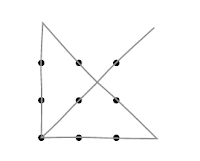
Chapter one also offered a common mind puzzle to demonstrate the thinking process. The puzzle asks to draw 4 straight lines connecting all the dots without lifting the pencil off the paper.


After struggling for some time, most give up - thinking it can't be done. "The frames our minds create define - and confine - what we perceived to be possible," (Zander & Zander, 2002, pg 14). How we look at things is a big indicator as to how successful we will be in dealing with them. Once confidence is established, as experience increases, success will also increase. Again, it takes practice in whatever is being done. Chapter one was all about understanding the situation well enough to think beyond it. It is only when we are comfortable that we can really create. Perhaps that's why high school students rarely amaze their teachers. They are being forced to perform in settings where they are not comfortable. Below shows how thinking beyond the situation solves the puzzle.
References:

Zander, R. & Zander, B. (2002). The art of possibility. London: Penguin Books.

EDM613 Wk1 Wimba Post

Watching the Wimba archive I was reminded why I'm going through this masters program. The discussion about how public schools react to changing technologies pointed out that technology needs more advocates. For the most part, public schools lag a good ten years behind cutting edge technology and only ever incorporate it if they can find a big enough budget. The things I have learned in this program look to combat those issues head on.

As an English teacher, I can relate to your instructions for the reading posts. I can't stand when my students just summarize what they read - I tell them whatever they are reading I've read at least 50 times. It is so important to get students out of the habit of summarizing and into the practice of analyzing. As a ninth grade teacher, it takes all year (and all my patience) to get them to make that shift.

Friday, May 7, 2010

EDM613 Wk1 DB Quickie - Topic 2 Tech in Workplace

I actually teach in the ATM academy at my school – Applied technology magnet, and have been complaining for years that we are far from a platform in which we apply technology on a consistent basis. I graduated from the high school I work at now in 1998, and the ATM academy has all the same electives today as they did when I attended the school as a student. Our claim that we provide current and cutting edge access to technology is far from true. I have been patiently working with a group of three other teachers to really achieve that vision.

I have moved much of my curriculum online, to provide my students the chance to interact with their work more. All my Power Points and lessons can be accessed online as well as tests, quizzes, homework assignments and various other materials. Currently, I have been building an LMS to facilitate my curriculum in conjunction with my action research project. I have brought in online forum discussions, Wikis, chat rooms, podcasts, videocasts, and other collaborative functions. I constantly introduce web 2.0 tools and other free applications such as Photostory, Udutu and googledocs to allow students opportunities to be creative, interact with their learning and become better organized.

I recently got headphones and microphones donated to my classroom and next year will have students creating podcasts for many of their assignments. I am also the journalism teacher and this year moved the school paper from the traditional newspaper to an online website. The teachers I am working closely with teach digital arts and web publishing and we are trying to create new electives that better align with today’s world. One of our biggest pushes is to create some medical field classes that would begin to teacher students how future technology will impact the skills they will need in medical careers.

Our goal is to create curriculum that is ever changing, so that we can continue to adjust as the technologies adjust. We don’t want to just spend money on computers and equipment, but rather teach students how to really get the most out of technology. A lot of what we want to do focuses on allowing students to set self-exploration goals and teach the classes as independent studies.

Sunday, October 18, 2009

BP16_2009103_one_minute_review_Vuvox


This video is aimed to administrators and teachers who fear change and technology but want their students to demonstrate critical thinking skills.

I actually used Vuvox to create it and recorded it with Screentoaster (another application I discovered this week).

Images and backgrounds from stockxchng.com 

Video and audio is linked to their actually websites

Thursday, October 15, 2009

BP15_2009103_Web2.0_Response_Blog

WEDNESDAY, OCTOBER 14, 2009

BP14_20091018_Researching and Blogging about Web 2.0


ClassTools.net

This site is tremendous! I love all the functionality of this site. There are so many options available in this site. I especially like the games that can be created. They are so easy to create and the students would be so engaged. It would be such a great tool for remediation, reinforcement of concepts, and assessment of material. I think I will get a great deal of use out of this site.

1 comments:

Tom McNamee said...

I really liked the classtools.net site. Looking through the site, I thought the jigsaw diagram was very powerful. I could see creating a graphic organizer with it and scrambling the pieces and having students put the puzzle together. I also liked the lights out activity and could see it used as a review of sorts.
While I like the site, I don’t think I could use it in my high school classes because it feels like it is more geared toward kids. If I were to use it, I think I would have the students use the site to create lessons that they can teach the class. I let my students do a lot of teaching, and this site has many tools that can build visuals for that purpose.